

March 19, 2026
Critter Mysteries: Yellowjackets and Cottonwood Leaf Beetles
Question:
We have a nest of what appears to be very busy yellowjackets on our property. We experienced a recent hard freeze and some snow, and the soil in my raised beds is frozen solid. Can you share some fun facts about these little fellas? Is the warm weather keeping them active or is this typical for them?
- Kasey M., Sandoval County
Answer:
In doing some preliminary research I found the following quote:
“yellowjacket colonies do not normally survive the winter and the first hard freeze will eliminate most colonies.” - See Yellowjackets from Clemson Cooperative Extension.
…which is incredible to see, after the cold snap that we experienced in the area late January (when these photos were taken)! The Yellowjackets & Hornets, from the University of Florida, also reports that colonies die off in the winter. However, it does seem like mild winters can allow yellowjackets to overwinter and colonies can survive for several years, according to IMP Yellowjackets from the University of California.
These are probably western yellowjackets (Vespula pensylvanica), since they are nesting in the ground. As long as you can safely avoid the nest, they can provide great pest control.
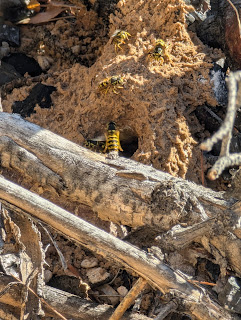
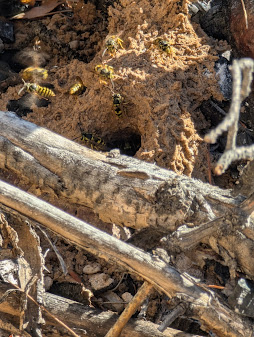
Photo credit: Kasey M. Sandoval County.
Here are some thoughts from our extension entomologist and extension IPM specialist:
"Interesting how active they have been, especially after a hard frost. That nest must be pretty well insulated." -- Joanna Bloese, NMSU Extension IPM Specialist.
"I love your positive attitude! If they aren't bothering anyone nearby, they could totally just hang out. Although they can be a nuisance, yellowjackets are overall beneficial insects. They are great natural pest control-- they feed their larvae tons of caterpillars, flies, and other insects. They are also incidental pollinators. Overall, they do much more good than bad (e.g., stinging)" -- Joanie King, NMSU Extension Entomologist.
Sources:
- Yellowjackets - Clemson Cooperative Extension Home and Garden Information Center. Hood. W.M. (1998).
- Yellowjackets & Hornets, Vespula and Dolichovespula spp. (Insecta: Hymenoptera: Vespidae) - UF/IFAS Extension. Grissell, E.E., Fasulo, T.R. (2017).
- IMP Yellowjackets, Integrated Pest Management (IPM) Handout for Family Child Care Homes - University of California. UCSF California Childcare Health Program. (2016).
- Yellowjackets and Other Social Wasps, Pest Notes 7450 - University of California Agriculture and Natural Resources Statewide Integrated Pest Management Program. Mussen, E.C. (2012).
Question:
Here's a photo of the bug I was hoping you could identify for me. I would say these are about a half-inch or 5/8 inches long. Thanks!
- Keith P., Sandoval County
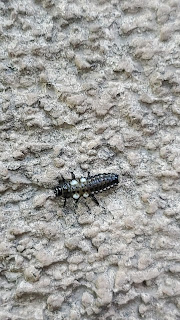
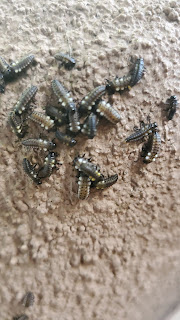
Photo credit: Keith P., Sandoval County.
Answer:
This took some more detective work with our Extension entomologist to answer. The soft body, powerful legs, and black markings made me think at first that these critters were ladybug larvae. I was also informed that these photos were taken during the summer. There are many kinds of beetle larvae, and after showing these to the Extension Entomologist, we believe these are not ladybugs, but the larval stage of the cottonwood leaf beetle:
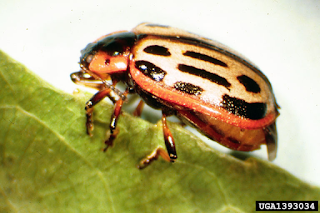
Photo credit: Insect Images.org, Dennis Haugen, Bugwood.org, CC BY-NC 3.0 US.
Here's a photo for comparison of ladybug larvae (feeding, ironically, on cottonwood leaf beetle eggs!).
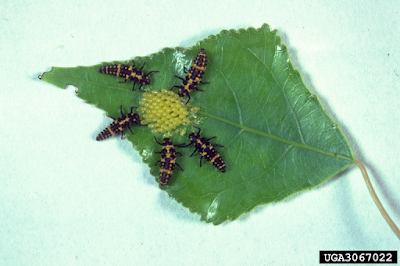
Photo credit: Insect Images.org, James Solomon, USDA Forest Service, Bugwood.org, CC BY-NC 3.0 US.
Cottonwood leaf beetles can be identified by their dark color and the white spots on the sides of their bodies (ladybug larvae are orange and black). They are not even in the same family as ladybugs, Coccinellidae, but in a separate family called Chrysomelidae. Unlike ladybug larvae, cottonwood leaf beetle larvae will not eat pest insects like aphids and instead feed on cottonwood leaves. Flea beetles are also in the Chrysomelidae family and can be seen as pest in gardens. Thankfully, the damage from cottonwood leaf beetles is generally aesthetic. The best thing you can do to protect a cottonwood from any deleterious effects from this pest is to keep the tree healthy, such as by watering appropriately and keeping the soil healthy.
Sources:
- Cottonwood Leaf Beetle, Chrysomela Scripta Fabricius (Insecta: Coleoptera: Chrysomelidae: Chrysomela) - UF/IFAS Extension. Chi, A., Mizell III, R.F. (2012, rev. 2020).
- Cottonwood Leaf Beetle Chrysomela Scripta - Utah State University Plant Health Extension Integrated Pest Management.
- Guide H-176: IPM Strategies for Common Garden Insect Pests of NM - New Mexico State University. Freeman, A.J., Kersten, M.L., Skidmore, A., Thompson, M.Y. (2021).
Bethany Abrahamson is the Cooperative Extension Agriculture Agent for Sandoval County.
Marisa Y. Thompson, PhD, is the Extension Horticulture Specialist, in the Department of Extension Plant Sciences at the New Mexico State University Los Lunas Agricultural Science Center, email: desertblooms@nmsu.edu, office: 505-865-7340, ext. 113.
Links:
For more gardening information, visit the NMSU Extension Horticulture page at Desert Blooms and the NMSU Horticulture Publications page.
Send gardening questions to Southwest Yard and Garden - Attn: Dr. Marisa Thompson at desertblooms@nmsu.edu, or at the Desert Blooms Facebook page.
Please copy your County Extension Agent and indicate your county of residence when you submit your question!